What it does
Grouped the way the work actually happens.
Catalog and editions
- Canonical title records. One book, with its print, ebook and audiobook editions beneath it, each carrying its own ISBN, trim size, page count, price and publication date. The shared facts live on the title and flow down, so a subtitle is corrected once.
- History and audit. Every change to a canonical field is recorded with what it was, what it became, where the change came from and why.
- Tasks. Created from what the app finds — a critical mismatch makes a task, and the same mismatch found twice does not make two.
ISBN registry
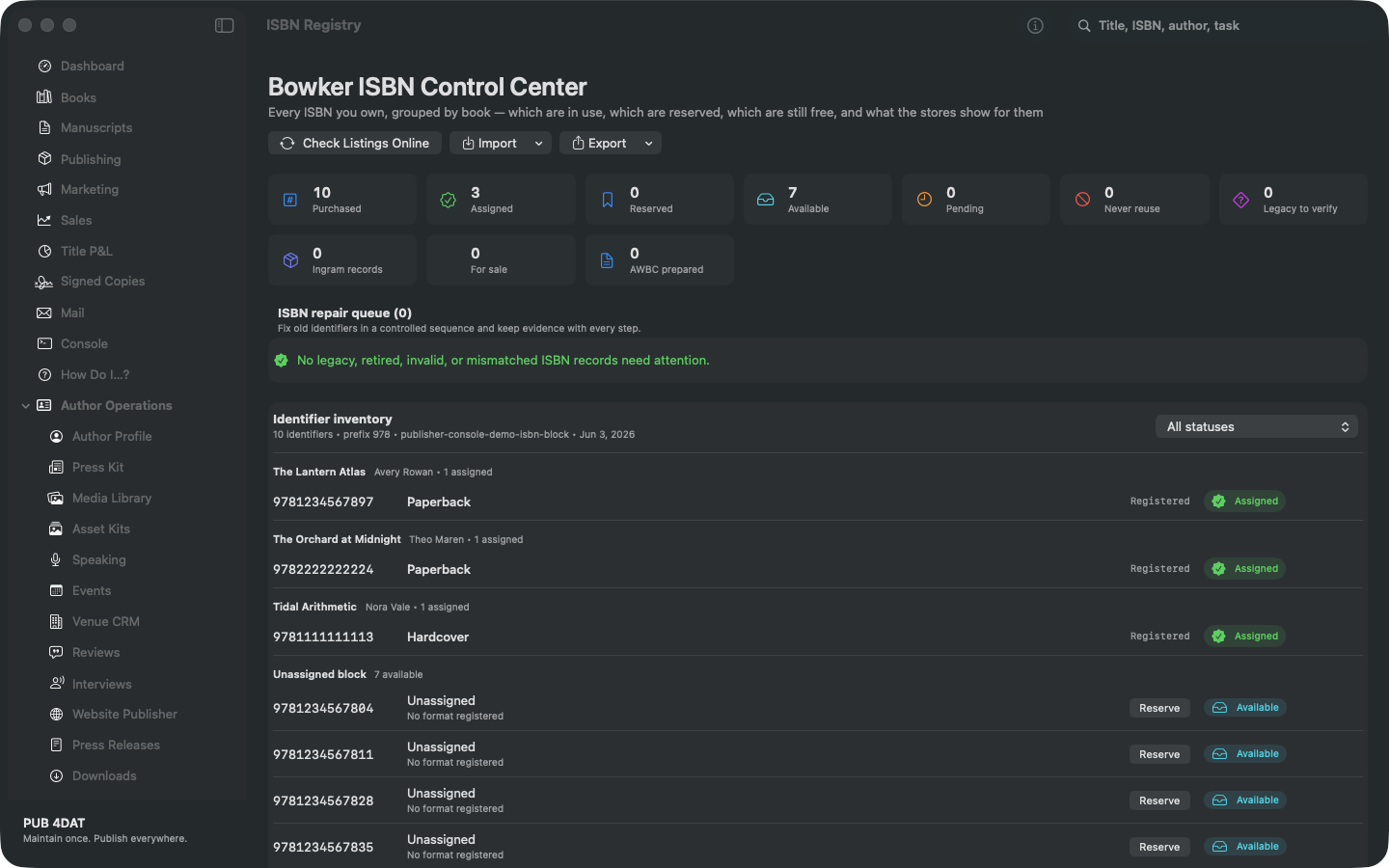
- Bowker block allocation. Purchased, assigned, reserved, available and retired, with the check digit verified on every number.
- Retirement protection. A retired identifier can never be reused, and the app refuses rather than explaining afterwards.
- The block's cost follows the numbers. A block of ten is one invoice for ten identifiers. Assign three to titles and three tenths of that invoice becomes those books' cost; the other seven tenths stay visibly unallocated instead of being spread around.
Platform verification and the transparency console
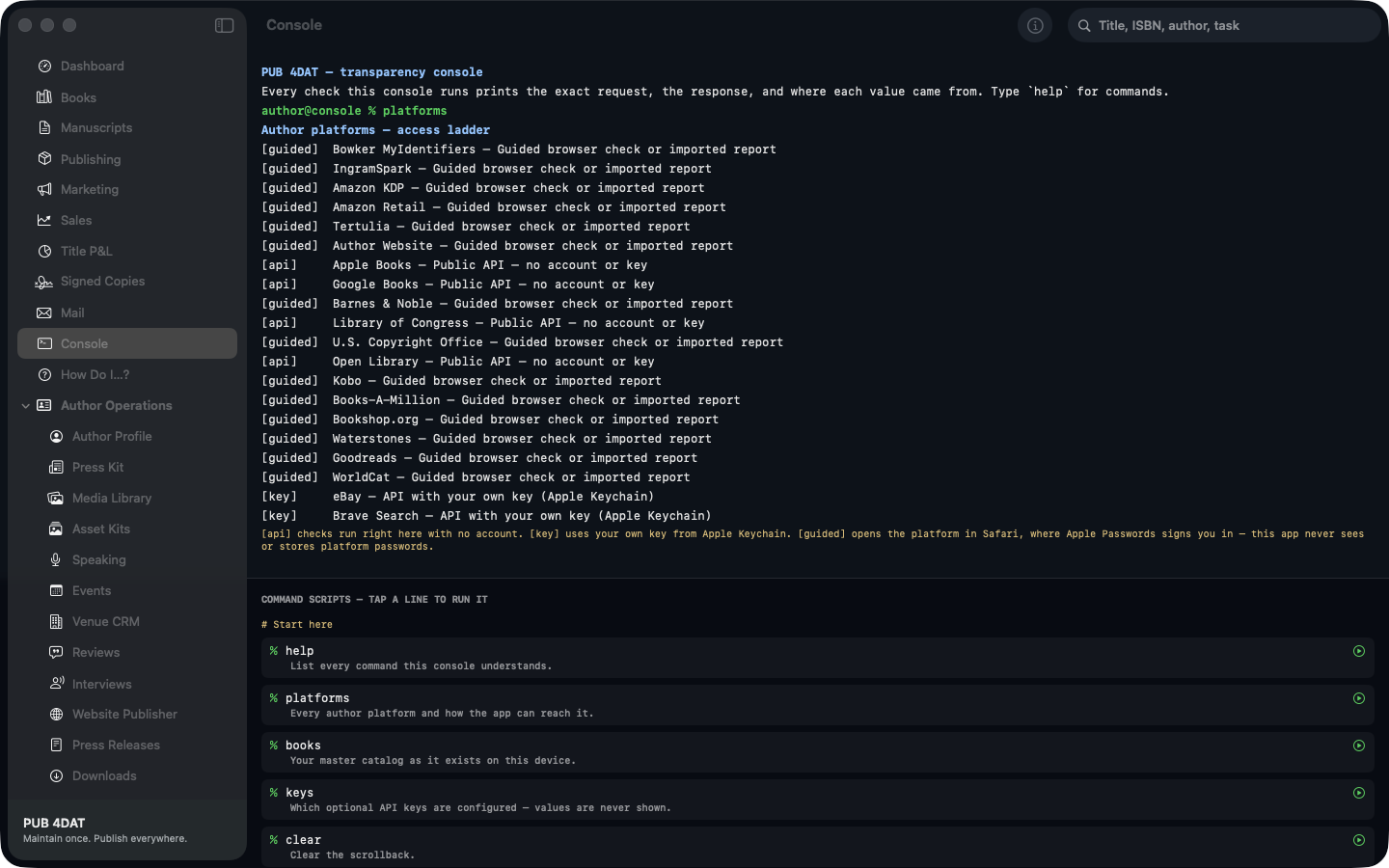
- A status board for 21 author platforms — Bowker, Amazon, IngramSpark, Goodreads, Apple Books, Google Play, Kobo, the Library of Congress, the Copyright Office and more — in five clear states, coded by symbol and label rather than by colour alone.
- The transparency console prints the exact request made, the response that came back, and whether each value was inherited from a platform or generated in your own catalog. Tap-to-run commands; nothing to memorize.
- Guided checks where automation is not allowed. Platforms that prohibit scraping get the exact click path and a place to record what you saw, labelled as your own reading. That is a deliberate limit, not a missing feature.
Metadata control
- Field-by-field comparison against what each external catalog is currently showing, with the discrepancy named and a Resolve action on each one.
- Snapshots of what a platform said and when, so "they changed it" is a record rather than a memory.
Copyright operations
- Preparation checklists per title, filing records, deposit tracking and publication-date reminders.
- The optional eCO user ID lives in the Keychain. The app never asks for the password.
Money
- Royalty import from Amazon KDP, Apple Books, IngramSpark and Google Play, each recognised by its own report signature and matched to your titles.
- Title P&L — in, out, net and break-even units per title, with portfolio totals free and the per-title breakdown in PRO.
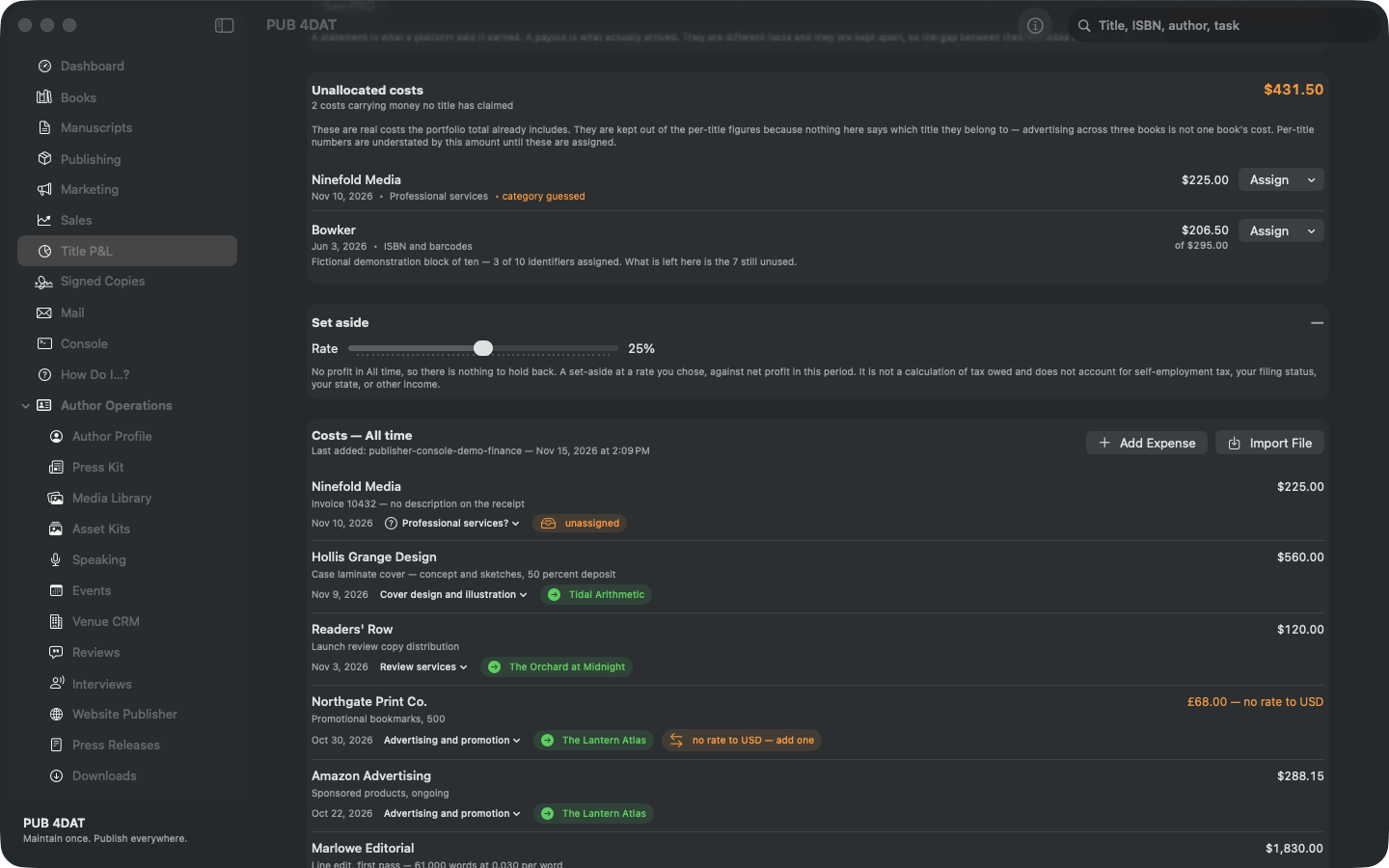
- Costs by import or by hand, in a fixed publishing taxonomy, with shared costs sitting in a visible unallocated pool until you assign them rather than being split evenly behind your back.
- Reconciliation — what each platform reported against what actually landed, with what is still owed and how old it is.
- Multi-currency that keeps its evidence. Every converted figure carries the rate, the date and where the rate came from, frozen at import. A figure with no rate is reported separately, never folded into a total.
- Year end — a Schedule C summary and four CSV exports, each naming what it could not include.
Reviews and reception
- Every review service you use — stores, reader communities, editorial reviewers, advance-copy services — with what each one allows to be checked, when the next check is due, and what came back.
- What reviews cost, against what they returned. A paid review is a cost like any other and lands in that title's P&L; the screen shows the spend beside the reviews actually in hand.
- Reception over time, plotted per platform and per way of reading it, against your release and review dates. A dashboard figure is never joined to a number read off a public page — they measure different things.
Direct sales and author operations
- Signed copies — orders from your own stock, with a Stripe invoice raised for the buyer. No card number ever reaches the app.
- Press kit, media library, speaking, events, venue CRM, interviews, website, releases, downloads and reader missions — the small things publishers do, with a record of each.